Raise the kids who direct the machines.
The most valuable thing in the AI century is a human who knows what they want to make. Not the fastest typist, not the kid with the most tabs open: the one who walks into a room full of powerful tools carrying an idea of their own. Your teenager already has that idea somewhere, half-formed, waiting. Twelve weeks here turns it into real things on the internet - and turns your teen into a high agency human the machines answer to.
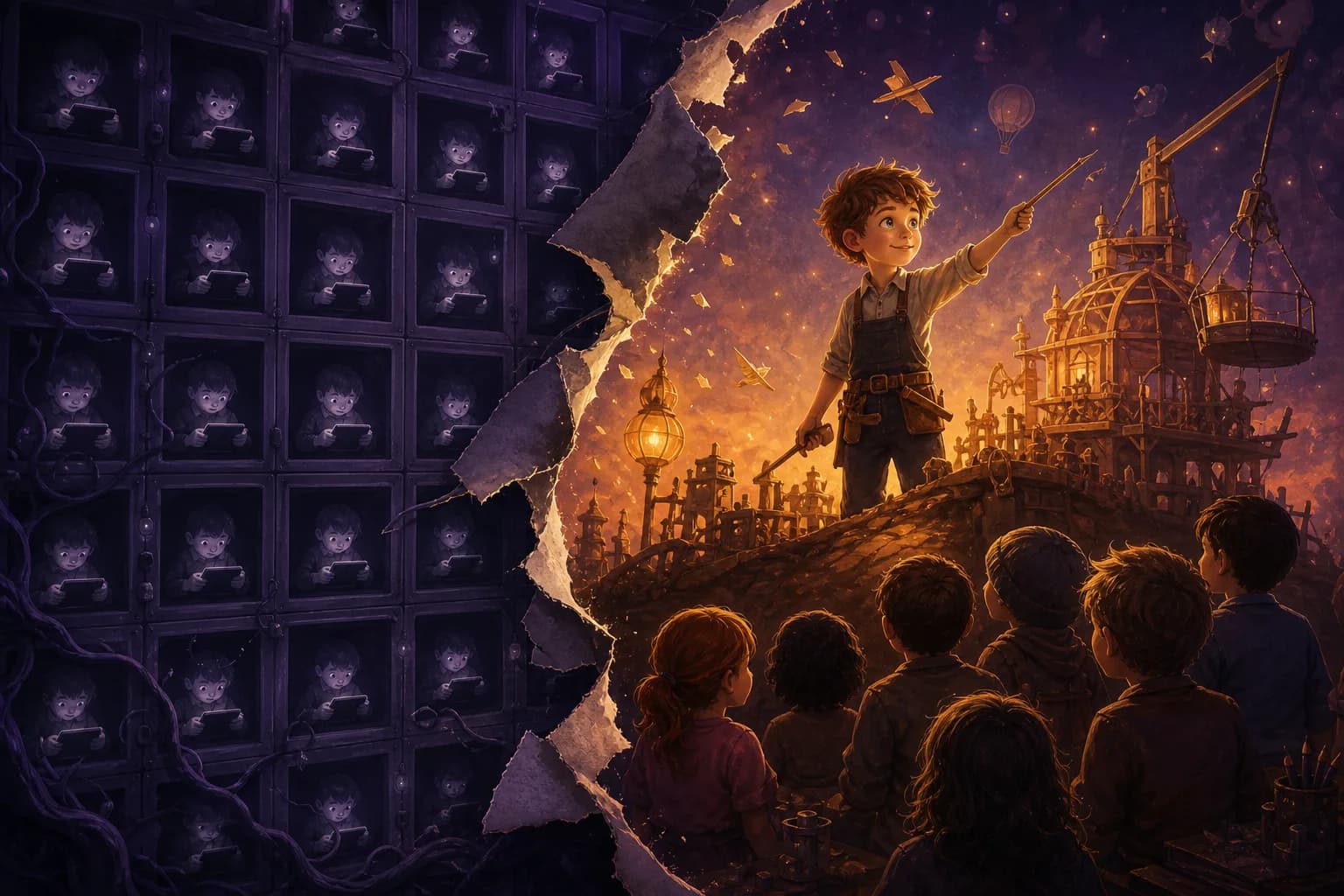
A kid who knows what they love and has learned high-agency tool use is unstoppable. A kid who knows prompts but has no direction is just a faster passenger.
There will be two kinds of adults in 2040.
The ones who direct the AI toward the things they love - who know what they want to make, and use AI as hands.
And the ones who were directed by them - fluent consumers of whatever the feed decides comes next.
Which one your child becomes is not a talent question. It's a training question - and it's being decided right now.
And the training is not coming from school. Most families say their school has never even communicated an AI policy - the default response has been bans and detection software, not instruction. Kids are walking into an AI-saturated world with the one institution meant to prepare them pretending it isn't happening. That gap is exactly what this program exists to close.
Twelve weeks. A crew. A rhythm that does not let up.
This is not a course your kid clicks through alone at midnight. It's a live crew with a weekly heartbeat: expert sessions, demo days, and a room full of other builders expecting to see what you made. Week 1 your kid names the thing they want to build. Week 12 they present it, live, to people who watched it grow. In between there is momentum - the friendly, relentless pressure of shipping something every single week. That rhythm is the machine that manufactures a high agency child.
Weekly expert sessions
One hour, live, every kid in the crew together, always recorded. Taught by people who use AI at the highest level - and by domain practitioners who build with it every day in their own craft. Every session ends the same way: kids leave with challenges, not notes.
Weekly demo days
Kids show prototypes, live links, and honest work in progress. Big crews split into small groups across time zones, so every kid presents to a room that knows their project. They trade tricks, steal techniques, and learn as much from each other's builds as from the sessions.
Peer community
Your kid joins other high-school-age builders who treat making things as normal. Not spectators, not scrollers: kids with live projects and opinions about each other's work. Ambition is contagious, and this is a room where it spreads.
How Kids Win With AI - the same six moves, start to finish
Watch anyone do great work with AI and you find the same six moves underneath: knowing what the machine is good at, catching it when it's wrong, keeping the ideas unmistakably your own. These are the common threads in every great human-AI collaboration - the moves that separate directors from passengers. Kids learn them young here, and keep them for life.

Everything starts with their spark.
The Spark is the thing your kid already can't stop thinking about - the game they know inside out, the hustle they run on the side, the routine they've perfected. The whole program is built to help each kid discover it, amplify it, and codify it into real work with their name on it. During onboarding, your kid sits down with a coach in a safe, unhurried conversation about what they actually care about - not what looks good on an application. And JARVIS is tuned for exactly this: helping the kid navigate toward the spark, not handing them someone else's.
Why it matters: a kid who cares about something can use these tools to become world class at their thing. The gamer builds the stats site their whole lobby uses. The sneaker flipper turns a phone full of listings into a real reselling storefront with inventory and margins. The lifter builds the workout tracker shaped around their own split. Same tools, wildly different builds - because the spark comes first.
- 1.Discover the spark - a real conversation with a coach, then a Spark Journal that captures what keeps surfacing.
- 2.Amplify the spark - point the best tools on Earth at THEIR thing and watch it grow fast.
- 3.Codify the spark - shipped projects, a portfolio, a named direction they can defend out loud.
Four moves, one loop. It spins faster every time.
Every project in the program runs the same loop - and presenting and sharing are part of the loop, not afterthoughts. The reaction a kid gets from sharing is the fuel that lights the next spark. That's why it's a flywheel: each turn makes the next one easier, and a kid who has run it a dozen times stops asking permission to build things.
 1
1Have a spark
It starts with something the kid genuinely cares about. Not an assignment - a want.
 2
2Use the tools
They direct the best tools on Earth at their thing, and the idea takes shape in days, not semesters.
 3
3Ship it
A real thing, live on the internet, with their name on it. It's not done until someone can meet it.
 4
4Share it
Demo day. They present it, field the questions, and feel the reaction - which lights the next spark.
What you should expect to feel.
We hold ourselves to three parent-side outcomes. If they aren't happening, the program isn't working - and the 30-day window means you find out early.
You should be blown away.
A 15-year-old who's into architecture pulls up a portfolio site full of building concepts and schematics and says “Mom, check out the building I want to build.” And your first thought is: there is no way my kid made this. That moment - the there-is-no-way moment - is the standard we build toward every week.
Your kid should yearn to log in.
Not because of streaks or points - because their project is in there, mid-build, and it's theirs. Screen time here is creator time, not consumer time: building, not scrolling. The hours look the same from the doorway. What comes out of them could not be more different.
The ROI should be obvious.
A portfolio of shipped work, the habit of directing powerful tools, and the confidence of a high agency human who has presented live a dozen times. Whatever the job market looks like in 2035, that is the highest-ROI investment you can make in their future - and you can inspect every piece of it on the dashboard.
400 real-world challenges.
Zero worksheets.
Twice a week, a challenge arrives from the bank: build the backyard weather station, launch the neighborhood dog-walking business, catch the machine being wrong, ship the newsletter. Every task arrives with a boilerplate kit - and ends with the same look-back ritual:
- →Where did AI accelerate you?
- →Where did it mislead you - and how did you catch it?
- →Where did human creativity and judgment kick in?
- →What did you verify, and HOW?
- →Shortcut or amplifier - which way did you use it today?
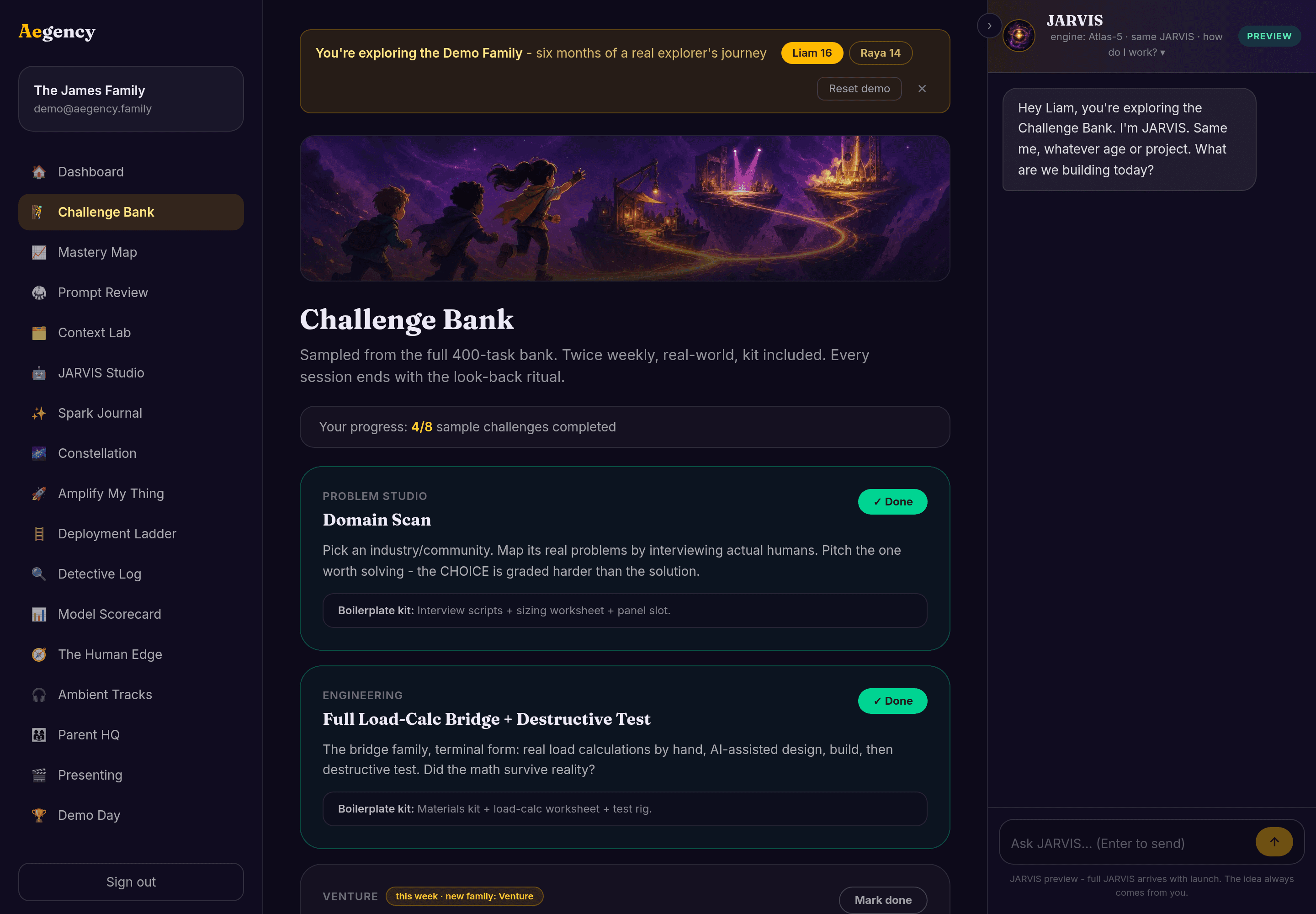
Build a Bridge
Everyone generates bridge designs for the same gap spec. Debate what AI got right and wrong, where human creativity kicks in, how to stress-test correctness - then build the best HYBRID design in spaghetti and load it until it snaps.
Catch the Machine Being Wrong
Kids race to find one AI mistake per session. Two-source rule: an answer isn't true until checked. Confidence ≠ correctness - learned as a game, kept as a habit.
Domain Scan
Map a real industry's problems by interviewing actual humans. Pitch the one worth solving. The choice is graded harder than the solution.

Learning that meets them in every mode of life.
Not everything happens at a screen. The academy's audio program carries the same ideas into the rest of the day: winding down after school, riding the bus, drifting to sleep. JARVIS on the site, episodes in the ears - the same ideas arriving through different doors, so they land deeper and stay longer.
Born from our original ambient audio experiments - “a nest made of voice, warmth, and steady breath” - and now grown into real series with one flagship: the weekly Frontier Briefings, capability shifts decoded for people whose projects depend on them. Parents keep borrowing the earbuds. Honest enrichment, never a babysitter.
What you actually see as a parent.
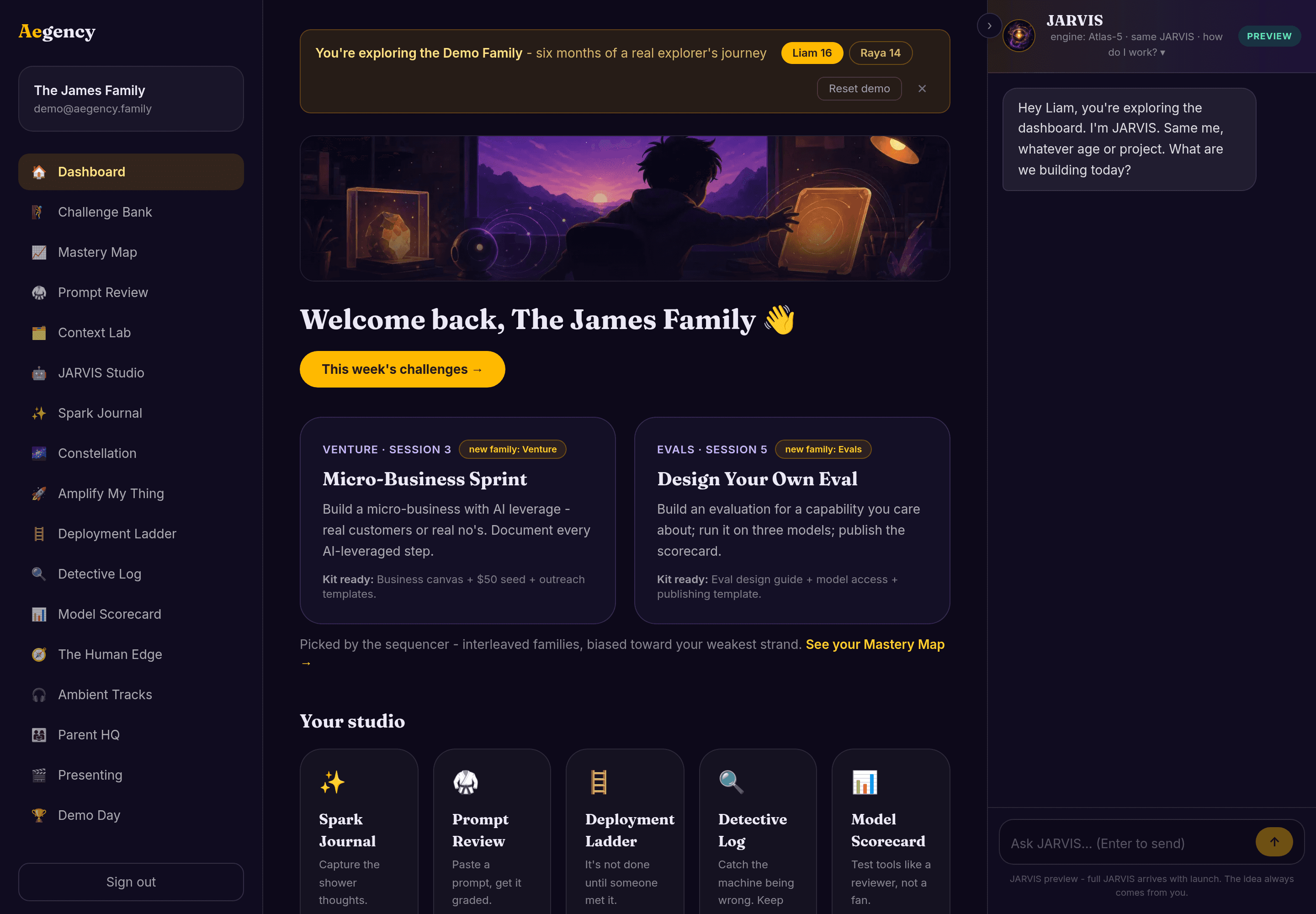
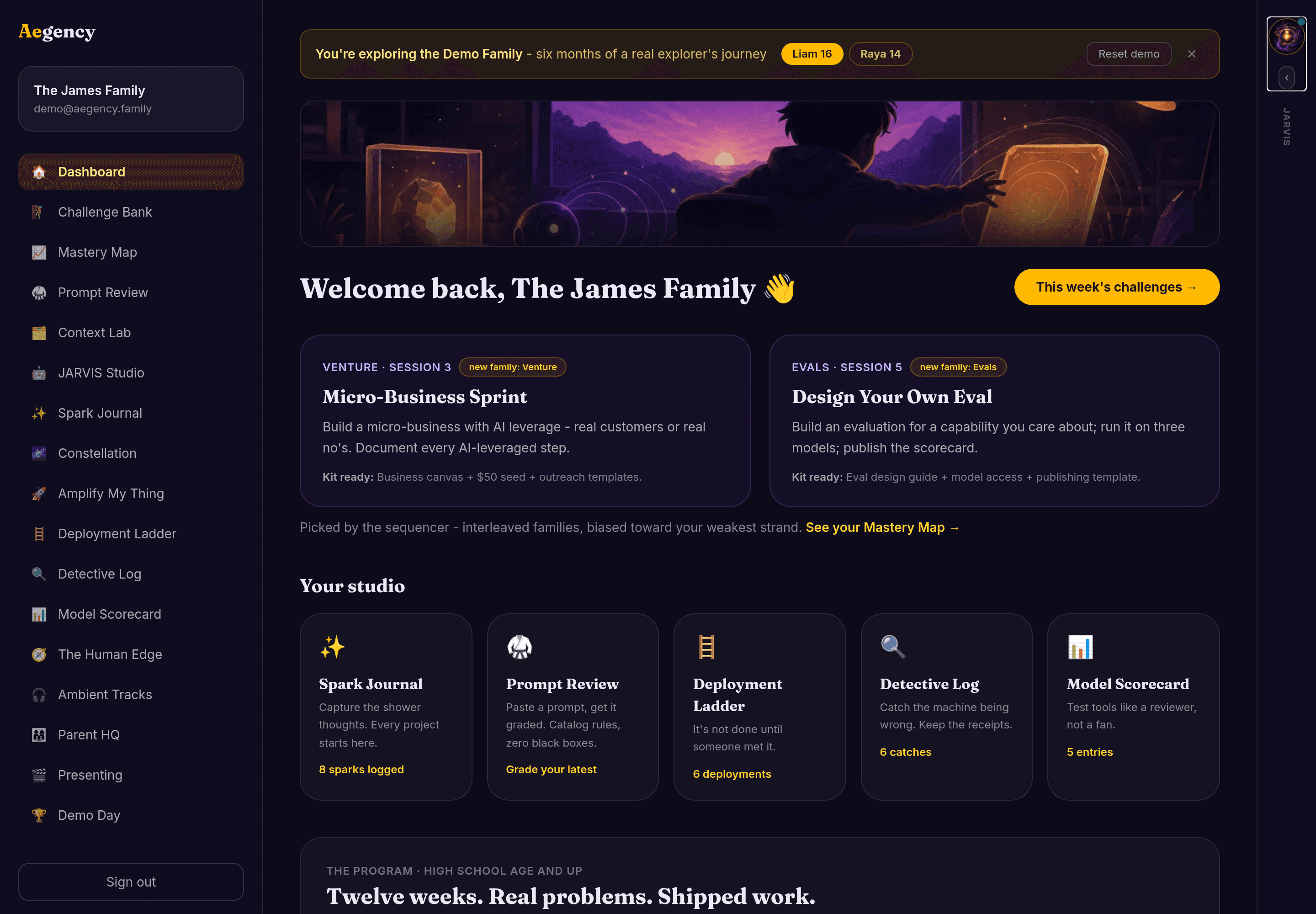
No engagement graphs, no streaks, no adjectives. The member area reports the real things your kid made, their verification habits, and rubric movement. These are real screenshots of the live product, populated with one demo explorer's six-month journey - honest demo data, not mockups.
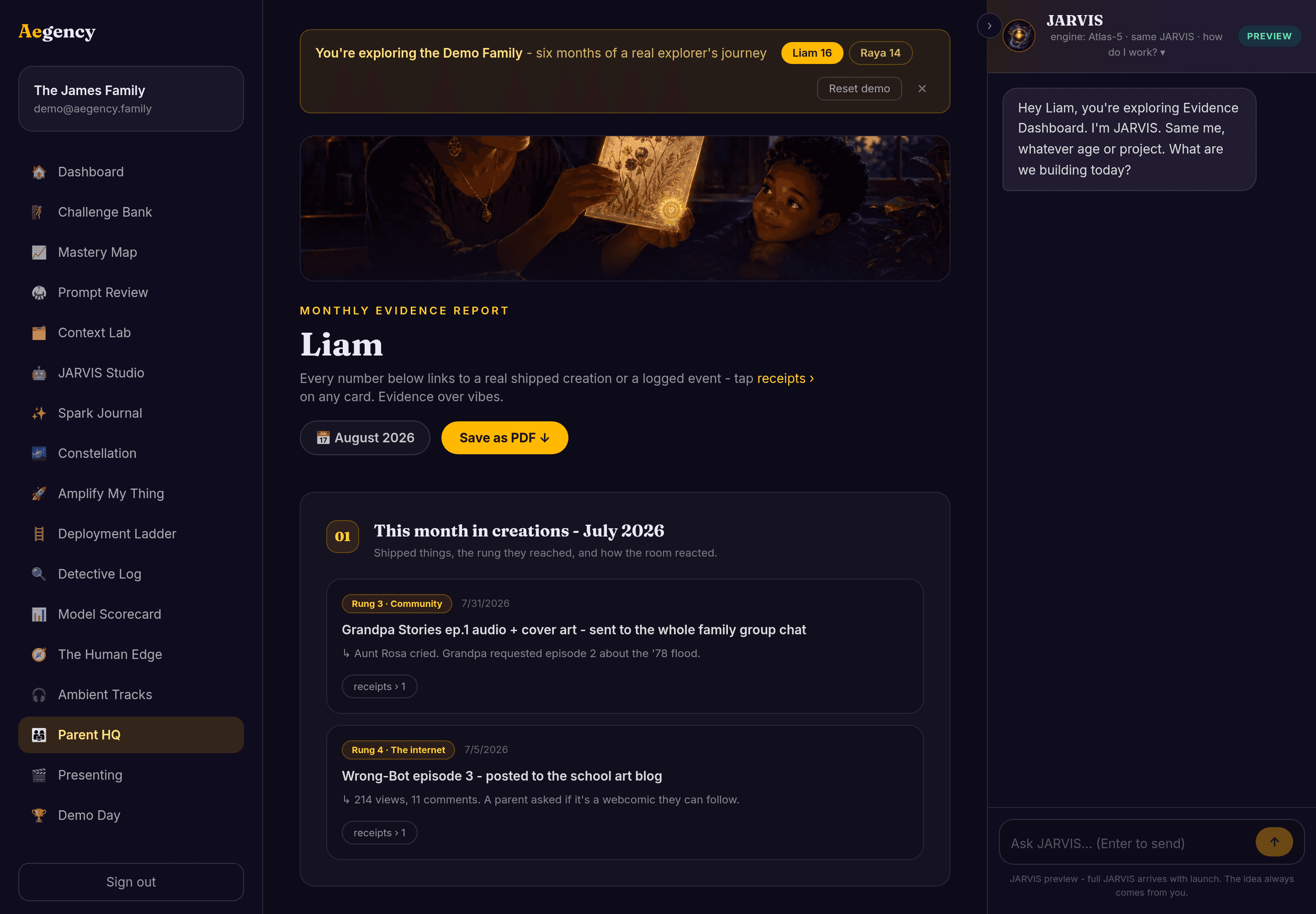
The Evidence Dashboard
Creations shipped, machines caught lying, rubric movement this season - the ROI view.
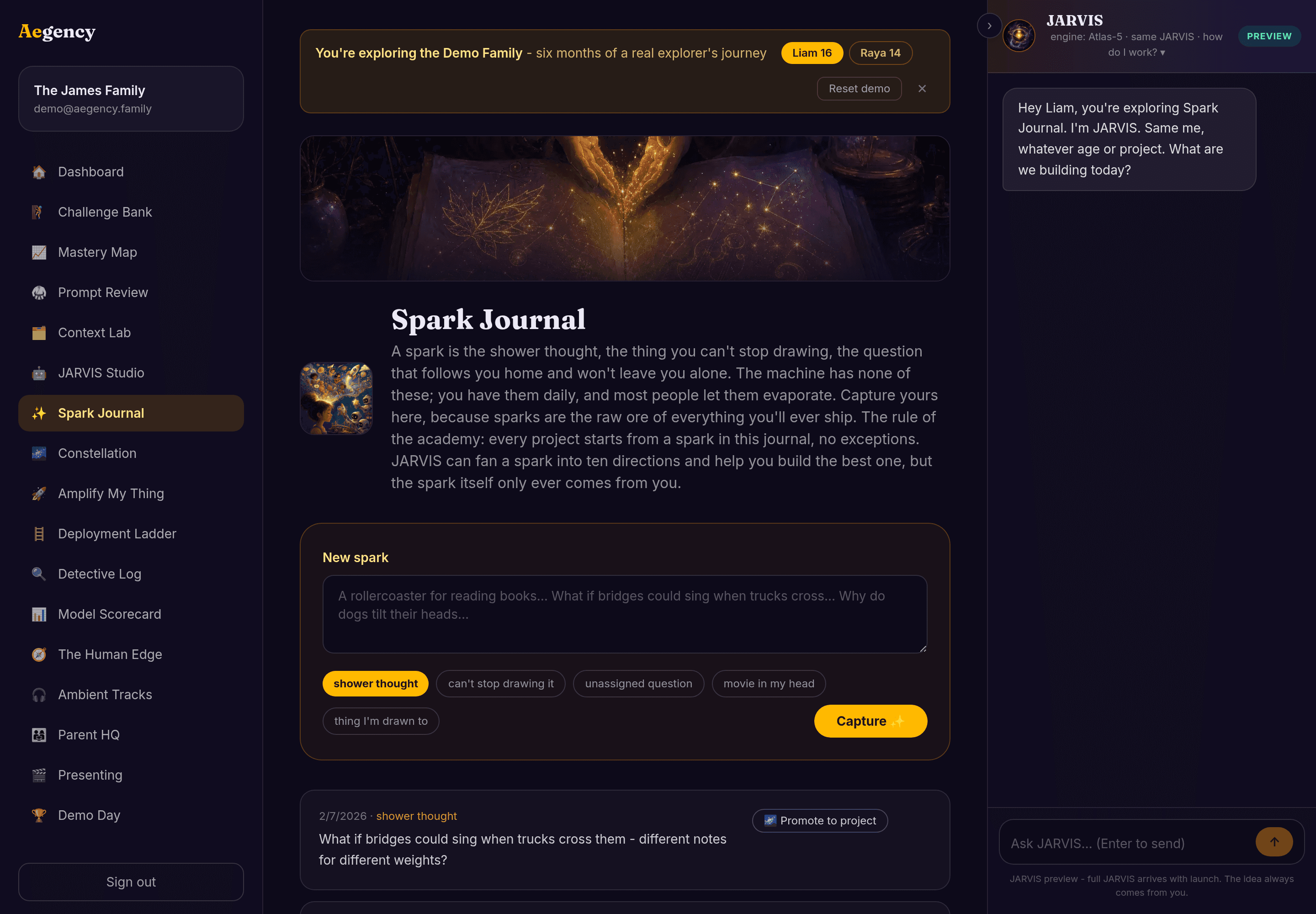
The Spark Journal
What your kid can't stop thinking about - captured, named, and turned into projects.
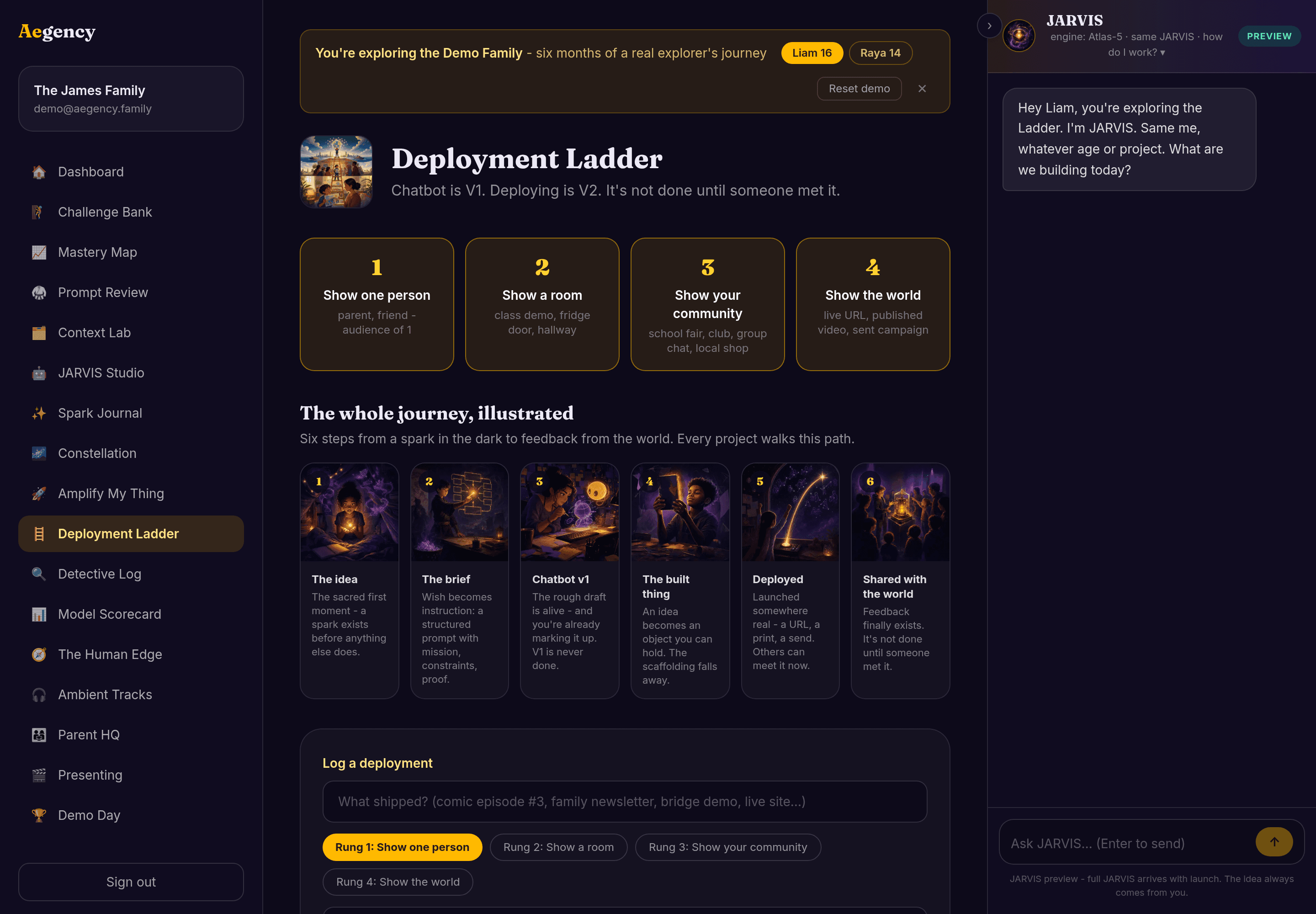
The Deployment Ladder
Every project ends on a rung: shown to one person, a room, a community, the world.
If the dashboard can't show real deltas, we haven't earned the renewal. That's the deal.

Meet JARVIS - the AI that grows with them.
On every page of the academy, ready to chat. It knows your explorer's sparks and projects, always runs the best current engine (models rotate underneath - same JARVIS), and it knows how to ship. Every lesson speaks the loop: “Use JARVIS on this page to…” And kids can always open the hood: model + memory + tools + mixing, inspectable by design.
No mystery friend, ever - JARVIS is a system your kid can explain: model + memory + tools + mixing.
God-tier prompt engineering, taught like a martial art.
Prompting isn't magic words - it's compressed clear thinking. Every explorer earns the belts of the craft, drawn from our living 100-strategy catalog. No competitor teaches this to kids as a discipline. We do.
Mission, autonomy, proof - one message, shipped.

The graduation exercise: brief an agent so well it ships the whole job from a single message - and you can defend every choice it made. Directors write briefs, not chat transcripts.
One bridge, one season, real users.
The same thread returns week after week, deepening. Watch a single theme - structures - carry an explorer from first sketch to a build strangers actually used. Grades expire; this compounds.
The sketch
Ten AI-generated designs for the same gap spec - and the first debate about which ones would actually stand.
The spaghetti build
The best hybrid design gets built for real and loaded until it snaps. The math meets the floor.
The load-calc rematch
Real load calculations by hand, AI-assisted design, destructive test. Did the math survive reality?
The real-world stress test
She runs a stress test on her own product with 50 real users - then ships the fix the same weekend. The math, the build, and the customers are all real now.
Bridges, money, games, design - every theme runs this same arc from first sketch to shipped-and-met.
Fourteen North Stars
Every lesson, challenge, and audio episode in the academy serves one of these. No buzzwords - doctrine.
 ✨
✨Agency & Your Spark
Your spark - shower thoughts, the movies in your head - can never be replaced. We cultivate it, help you name it, then amplify it.
The entire academy is about the human element: what YOU are drawn to, your skills and curiosities - then using AI tools to amplify those. Not 'learn AI because jobs.' Excited about cartoons? Flowers? Dress design? Same question every time: how do you use these tools to create, share, and be the best in the world at YOUR thing. Order matters: cultivate the spark, understand the spark, amplify the spark. A kid who knows prompts but has no direction is just a faster passenger.
 🪜
🪜Stage 1 → Stage 2
Talking TO the AI is Stage 1. Working WITH an AI that has hands is Stage 2 - high-agency mode. We teach the ladder explicitly.
Most people think 'using AI' means typing into a chatbot. That is rung one. Stage 2 systems use tools - search the web, run code, make files, check their own work. Once the AI has hands, your job changes from typist to DIRECTOR. Stage 2 must be taught: kids don't discover directing on their own - the chat window's gravity is passive Q&A.
 🚀
🚀Chatbot is V1. Deploying is V2.
Deployment = making your thing real and putting it where other people can meet it. Feedback only exists after deployment.
Deploy is not a programmer word. Posting a comic episode, sending a newsletter, hanging a print, emailing ten people about your idea - all deployments. The kid-sized ladder: show one person → show a room → show your community → show the world. Every project in the program ends on a rung. It's not done until someone met it.
 ⚙️
⚙️Models Come and Go
Model ≠ AI. The model is one replaceable part. What matters is the mix: model + memory + tools + orchestration.
The best model rotates constantly; this year's champion is next year's also-ran. Kids must not anchor their identity on any product name. We teach the system view: a mediocre model with great memory and tools beats a genius model trapped in a chat box. Component understanding survives every release cycle - and gives hype immunity.
 🎤
🎤The Human Communication Ceiling
Working theory: the best passionate human communicators stay out of AI's reach. Taught as an open question, not a fact.
Pick your favorite comic, author, YouTuber. Name three things that make them great. Test the AI on exactly those three things. Compare honestly. Develop your own dated, revisable thesis - and re-test it against the new best model next year. If the theory holds, kids find the durable human high ground. If it breaks, our kids notice first - with evidence.
 🧭
🧭The Uniquely-Human Trio
In an AI-pervasive economy, durable human value concentrates in problem selection, creativity, and mastery of the tools.
AI will be pervasive in every business and every task. The whole program grows the three capacities machines don't own: choosing which problems matter, original taste and imagination, and directing the tools masterfully. AI is the amplifier - never the substitute - for the child's own mind.
 🌉
🌉The Long Game
Grades expire and streaks reset. A portfolio of shipped work - and the habits that made it - compounds for decades.
We don't optimize for Friday's quiz or a login streak. The same themes return and deepen: the sketch becomes the prototype, the prototype becomes the load-tested build, the build becomes the thing real users met. What accumulates is a portfolio anyone can inspect and habits nobody can take away - noticing, verifying, directing, shipping. That's the asset we're actually building.
 🧾
🧾Evidence Over Vibes
Parents never get asked to trust our vibe. You see the real things your kid made, verification logs, and rubric movement - not minutes-watched.
Most kid-tech reports engagement because engagement is all it has. We report what the child made, what they verified and how, and where they moved on a rubric this season. If the dashboard can't show real deltas, we haven't earned the renewal. And we hold our own marketing to the same rule: no claim on this site that a real creation can't back.
 🎟️
🎟️Kid Is the Customer, Parent Is the Investor
If the kid doesn't beg to come back, nothing else matters. If the parent can't see the ROI, nothing else lasts.
Two contracts, honored separately. For the child: challenges that feel like missions, demo days that feel like premieres, tools that make their own ideas bigger. For the parent: an evidence dashboard that answers “what did my money grow this quarter?” in made things, not adjectives. We refuse to buy the kid's attention with slot-machine mechanics and call it learning.
 🔮
🔮JARVIS - the AI That Grows With Them
One persistent companion for the whole journey. Engines rotate underneath; JARVIS stays - it knows their spark, and it knows how to ship.
Every explorer gets JARVIS: always running the best current engine, always carrying the child's Spark Graph - what they love, what they've built, what they're chasing - and always fluent in the deployment rails. The relationship persists across every model release. And it's never a mystery friend: JARVIS is a system your kid can explain - model + memory + tools + mixing.
 🥋
🥋God-Tier Prompt Engineering
A dedicated Prompt Dojo strand runs the length of the program, drawn from a 100-strategy catalog - capped by the JARVIS One-Shot Canon.
Prompting isn't magic words; it's compressed clear thinking. The belts of the craft build in order - from “instructions must be precise” through role-setting, decomposition, and verification scaffolds - drawn from our living 100-strategy catalog. The summit is the One-Shot Canon: mission, autonomy, proof - one message, shipped. Directors write briefs, not chat transcripts.
 🗣️
🗣️Lead Humans With the Freed Brain Juice
AI hands back hours of grunt work. We reinvest them in the oldest scarce skill: moving people.
When the machine handles the drafts, the human differentiator moves up the stack - to rallying people around a thing worth making. So kids teach-down (explain this week's build to someone newer to the craft), host Demo Days (run the room, field the questions), and ship rally creations: the pitch, the invitation, the recruitment post. Machines don't follow leaders. Humans do - and that market never rotates.
 🎬
🎬Present, Share, and Lead Humans
Presenting is scary, and it is a skill. We train it weekly at demo days until standing up feels like a rep, not a risk.
As AI hands kids more leverage and frees more of their hours, the differentiator moves to the front of the room: standing in front of humans, showing the work, and leading what happens next. That is the share turn of the flywheel - spark, tools, ship, share - and it is trained, never assumed. Three minutes, a real audience, real questions, every single week. The first demo shakes. The tenth one doesn't.
 🗂️
🗂️Context Is the Superpower
What you feed the machine decides what you get back. Rich context beats clever phrasing every time.
Context is the working memory you hand the machine: your notes, your examples, your constraints, your prior work. Kids learn what it is, why the same request lands completely differently with it, and how to run it like a craft - gather it before you ask, structure it so the important parts lead, and preserve it across projects so JARVIS picks up long-running work exactly where it stopped. Directors don't just write instructions. They pack the briefcase.
Against the alternatives you're already paying for.
An honest table - every alternative here has a real strength, and we've written it down. The question isn't which is good. It's which advantage still exists in 2040.
| SAT tutoring | Coding bootcamp | AI tutor apps | Free YouTube | Aegency | |
|---|---|---|---|---|---|
| Cost per year | $1,000-$6,000 a season | $500-$4,000 per camp/course | $50-$500, cheap and scalable | $0 - genuinely free | $990-$4,990 per year |
| Advantage horizon | Real score gains - but the edge expires at admission | A skill - until the tools shift under it (they are, fast) | Better homework help this semester | As long as motivation survives the algorithm | Habits and a portfolio designed to compound to adulthood |
| What the kid produces | Practice tests and a score report | Course projects - often the same app as every classmate | Completed exercises and chat threads | Occasionally something great; usually watch history | Real shipped creations with real audiences, every season |
| Who does the thinking | The kid - genuinely, on test-shaped problems | The kid, inside a fixed syllabus | Shared - and the shortcut habit is one paste away | The video author; the kid mostly watches | The kid directs; AI amplifies - and the debrief checks who did what |
| Evidence you get | A number - clear, comparable, and it does move | A certificate and a demo day | Streaks, minutes, and engagement graphs | None - you'd have to build the tracking yourself | The real things they made, verification logs, and rubric movement on a parent dashboard |
Yes, SAT tutoring really moves scores and YouTube really is free. We're not competing on those axes.
The questions you're actually asking.
Direct answers. No hedging, no hand-waving.

Why isn't my kid's school teaching this?+
Ask them - most families who do get silence. In national surveys, a large majority of secondary-school parents say their school has never communicated any AI policy at all, and the most visible institutional responses have been bans and unreliable detection software. Parents on forums keep asking the same question: are schools teaching kids to use AI responsibly, or just banning it? Meanwhile kids are told the defining tool of their working lives is off-limits - the exact opposite of preparation. We're not anti-school and we're not anti-caution. We're the structured, opt-in, outside-of-school answer for families who don't want to wait for the institutions to catch up.
Isn't this just ChatGPT homework help?+
It's closer to the opposite. Homework-helper apps optimize for faster answers; we train the director's seat. Every challenge ends with the same look-back ritual - where did AI accelerate you, where did it mislead you, what did you verify and HOW - and two-track exercises make kids do the task solo and amplified so they can see the difference in their own work. The output of the academy isn't answers. It's a kid who chooses problems, directs tools, and ships things with their name on them.
Why high school age?+
Because this is the moment the training actually bites. A high schooler can reason abstractly, run an extended project, and feel real stakes - which means they can do the real thing: pick a problem worth solving, direct agent workflows, verify the output, and ship to an audience that isn't family. It's also the age the shortcut habit tries to calcify, so the amplifier discipline lands exactly when it's needed most. One program, one standard, no kiddie tier.
Is there an age cap?+
No. The floor is high-school-age thinking; there is no ceiling. Plenty of the material - problem selection, verification architecture, the one-shot brief - is the same craft working adults are scrambling to learn right now, and parents who lean in tend to discover they're getting a second seat in the program. More than one family has told us the parent learned more than they expected. If your teen enrolls and you find yourself doing the katas after they go to bed, that's not a bug.
What if the models change?+
They will - that's a design assumption, not a risk we're hoping away. We teach the system view from day one: the model is one replaceable part of a mix (model + memory + tools + orchestration), and this year's champion is next year's also-ran. Kids who understand components don't anchor their identity to a product name, and the curriculum's invariants - problem selection, verification, creativity, shipping - survive every release cycle. When the models change, our kids upgrade their toolkit and keep moving.
Why yearly?+
Because the billing period is the evidence cycle. Real habits and real portfolios move on seasons, not weeks - a monthly plan would push us toward engagement tricks to survive each renewal, which is exactly the product we refuse to build. A year buys a full arc: sparks captured, projects shipped, rubric movement you can see on the Parent Evidence Dashboard. And the 30-day full-refund window means you check the evidence early, before you've committed anything you can't get back.
Is the AI doing the work?+
That's the failure mode we police hardest - we call it spark-laundering: passing machine output off as the child's thinking. The rules against it are structural, not honor-system: every project roots in the child's own Spark Journal entry, decision logs record what the kid decided versus what AI generated, look-backs ask “shortcut or amplifier?” after every session, and demo days require the child to explain and defend the work live. AI writes the thinking down. It must never do the thinking.
Inside the product.
Six months of one explorer's journey - sparks captured, bridges shipped, machines caught lying, engines graded, theses filed. This is what your child's member area actually looks like.
JARVIS - Everywhere
One companion, every season, every page.
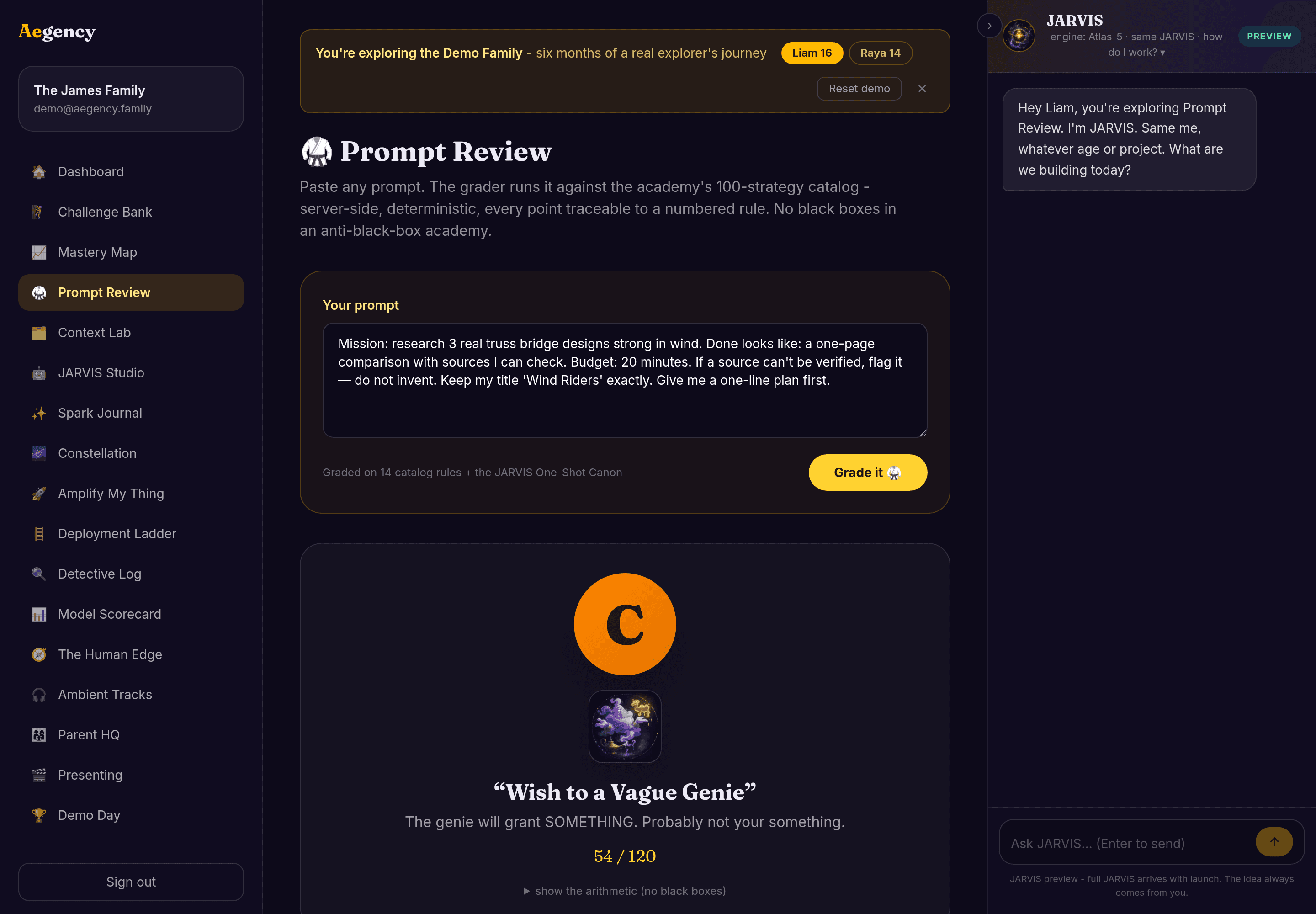
Prompt Review
Paste a prompt. Get an autopsy.
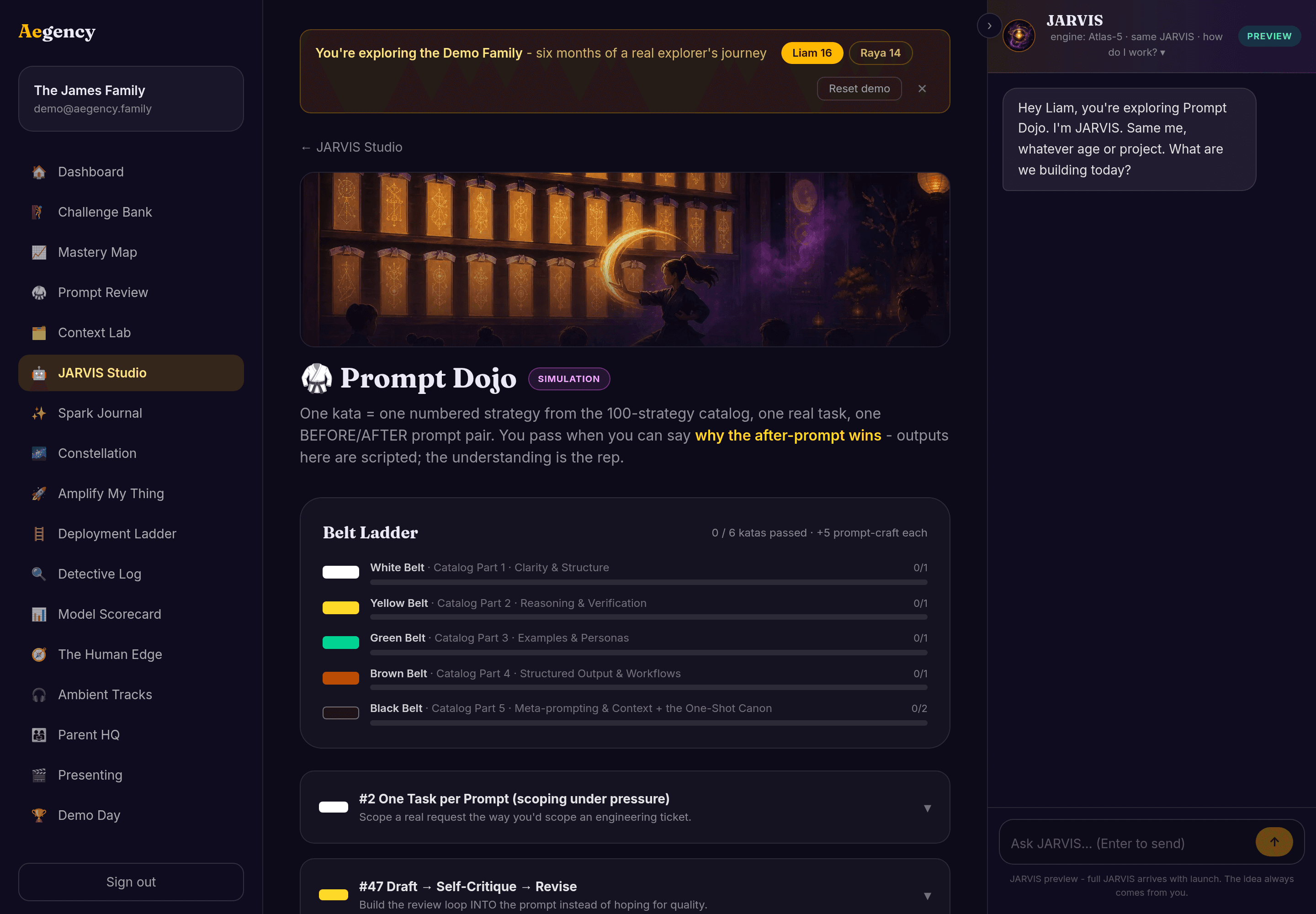
Prompt Dojo
A martial-arts curriculum for talking to machines.
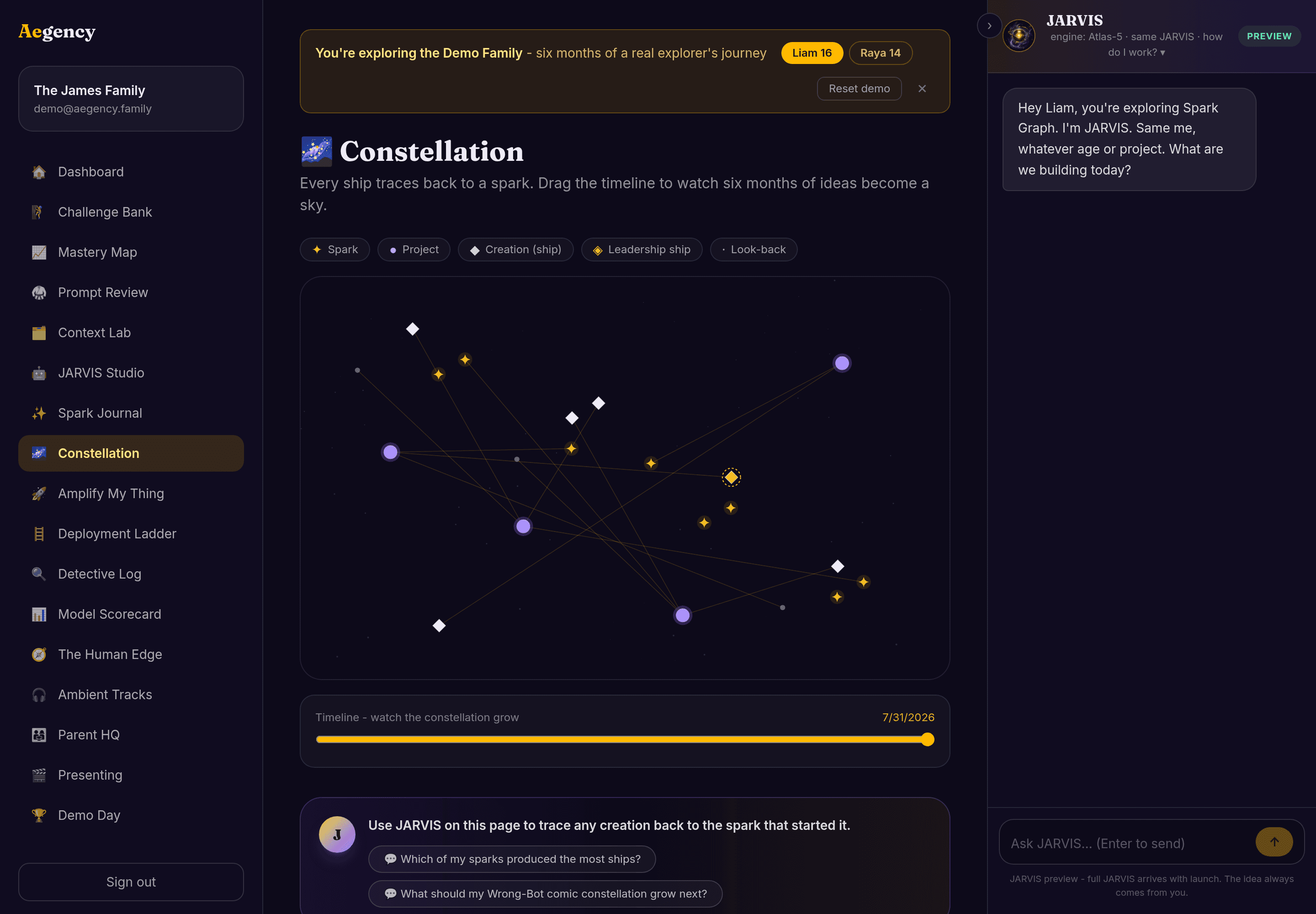
Spark Constellation
Seasons of curiosity, drawn as a night sky.
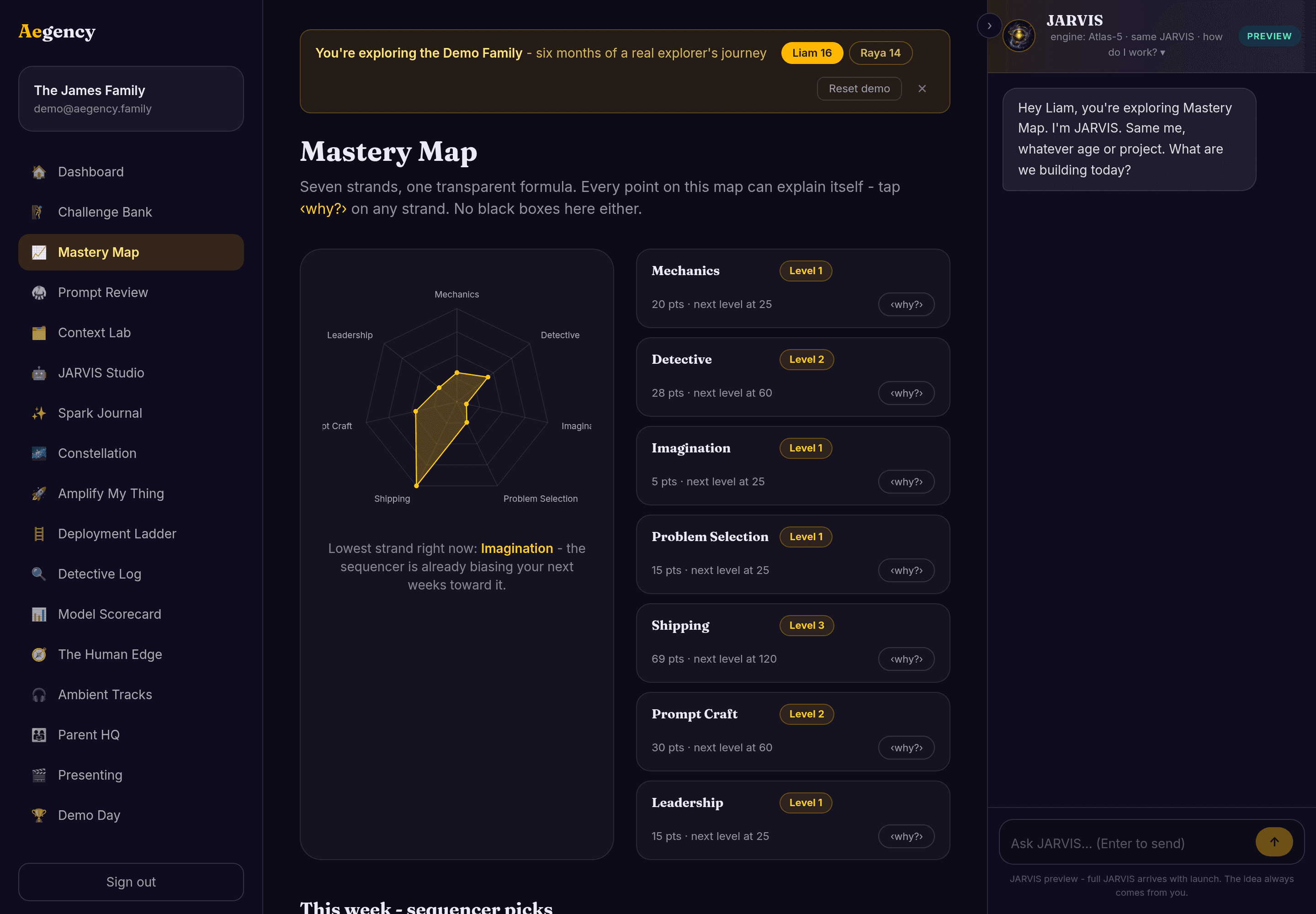
Mastery Map & Sequencer
The engine that decides what Tuesday's challenge is.
Evidence Dashboard
The ROI view: what actually got made, caught, and verified.

Demo Day - a science fair raised to a film premiere, and the kids run the room.
19 features, research citations included.
Priced like what it replaces.
Parents pay $1,000-$6,000 a season for SAT tutoring - months of prep for one test whose advantage expires at admission. This is the same investment, pointed at an advantage that compounds for life.

Spark
The full academy for one explorer.
- ✓Full 12-week curriculum + challenge engine
- ✓Spark Graph, Ladder & all studio tools
- ✓Ambient Tracks audio program
- ✓Parent Evidence Dashboard
- ✓Ship Rails: parent-gated publishing

Family
Every kid in the house, one shared craft.
- ✓Everything in Spark, whole crew
- ✓Full curriculum for every enrolled kid
- ✓Sibling progress dashboards
- ✓Monthly live parent workshop
- ✓Family Demo Day priority

Academy
Live mentors. Real panels. Judged capstones.
- ✓Everything in Family for one child
- ✓Weekly live mentor crew
- ✓Quarterly problem-pitch panels
- ✓Externally-judged capstone track
- ✓Priority showcase slots

Classroom
The full 400-task engine for teachers.
- ✓30 student seats
- ✓The full 400-task challenge bank
- ✓Boilerplate kits + look-back scripts
- ✓Teacher guides + training
- ✓Classroom analytics

30-day full-refund guarantee - the Parent Evidence Dashboard shows you real creations, real verification habits, real deltas before the window closes.
Founding Families: first 100 enrollments lock Spark at $990/yr for life.
The gap is being decided right now.
The most valuable thing in the AI century is a human who knows what they want to make. Your child's spark is already there. The question is whether it gets discovered, amplified, and codified - or spent scrolling someone else's.
Join the waitlist →